



Chiropractor for Headache in Singapore: What to Consider
Headaches can have many causes, and the appropriate approach depends on the type of headache and the person’s overall health. Some people consider a chiropractor for headache concerns when neck discomfort, movement or musculoskeletal factors appear to be involved. Research suggests spinal manipulation may help some people with cervicogenic headaches, which originate from problems involving the neck, but evidence across headache types remains limited or inconsistent.
Before beginning chiropractic care, the headache should be assessed rather than assuming it is caused by the spine or neck. A chiropractor for headache concerns should ask about symptoms, medical history, medications, previous injuries and changes in the headache pattern. Certain headache symptoms require prompt medical assessment rather than chiropractic treatment, especially when pain begins suddenly and severely or occurs with neurological symptoms.

* Dr. Nelson Lim Ping Wei
139 Cecil Street #03-02
Singapore 069539

* Dr. Neo Zhe Wei
35 Rochester Drive,
#02-19 Rochester Mall
Singapore 138639
 9187 0285

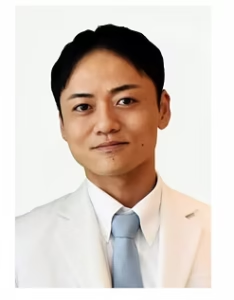


* Dr. Timothy Lim
237 Alexandra Road,
#05-12 The Alexcier
Singapore 159929

* Dr. Valerie Teo W. Q
180B Bencoolon Street,
#05-03 The Bencoolen,
Singapore 189648
Frequently Asked Questions
What types of headaches might involve the neck?
A cervicogenic headache is a type of headache in which pain originates from structures in the neck.
It may be considered when symptoms appear to have a musculoskeletal or cervical component. However, headaches can also have many other causes, including migraine, tension-type headache, illness, medication-related factors and other medical conditions.
NCCIH reports that research suggests spinal manipulation may reduce the frequency and intensity of cervicogenic headaches, although this does not mean every headache is suitable for chiropractic management.
A chiropractor for headache concerns should therefore first assess whether the presentation appears appropriate for chiropractic care.
Can chiropractic care help with headaches?
The answer depends partly on the type of headache.
Research reviewed by NCCIH suggests spinal manipulation may help some people with cervicogenic headaches. However, NCCIH’s broader review of complementary approaches for headaches states that evidence for spinal manipulation remains limited or inconsistent overall.
A 2020 systematic review specifically examining cervicogenic headache also evaluated spinal manipulative therapy, but the available studies varied in quality and methodology.
For this reason, a chiropractor for headache should not promise that chiropractic treatment will eliminate headaches or migraines.
What should a chiropractor ask before treating a headache?
Assessment should happen before treatment is recommended.
A chiropractor may ask about:
- When the headache first started
- Where the pain is located
- How often headaches occur
- How long each episode lasts
- Whether the headache has recently changed
- Neck pain or stiffness
- Previous head or neck injuries
- Current medications
- Existing health conditions
- Vision changes
- Nausea or vomiting
- Weakness, numbness or other neurological symptoms
This information can help determine whether the symptoms appear musculoskeletal or whether medical assessment may be needed.
Patients can also review What Makes a Good Chiropractor when considering how a practitioner should approach assessment and communication.
When should a headache receive medical attention instead?
Some headache symptoms require medical assessment rather than routine chiropractic care.
Urgent or emergency assessment may be appropriate when a headache:
- Begins suddenly and is extremely painful
- Occurs after a significant head injury
- Is accompanied by weakness or numbness
- Occurs with difficulty speaking or walking
- Is associated with confusion or loss of consciousness
- Occurs with a seizure
- Is accompanied by fever and a stiff neck
- Is substantially different from previous headaches
- Continues to worsen
The NHS advises emergency assessment for sudden, extremely painful headaches and headaches associated with symptoms such as seizures, weakness, numbness, speech problems or balance difficulties.
A responsible chiropractor for headache should recognise circumstances in which referral or medical assessment is more appropriate than proceeding with treatment.
Are spinal adjustments always used for headache care?
No.
Seeing a chiropractor does not automatically mean that spinal manipulation must be performed.
The practitioner may consider the patient’s symptoms, examination findings and health history before deciding whether a manual technique is appropriate.
Spinal manipulation involves applying a controlled thrust to a spinal joint, while mobilisation generally uses slower movement within the joint’s normal range.
Patients who want to understand these techniques can read more about Chiropractor Spinal Adjustments.
Is neck manipulation safe for someone with headaches?
Neck manipulation requires appropriate assessment and informed discussion.
Temporary effects after spinal manipulation can include increased discomfort, stiffness or headache. NCCIH also notes rare reports of serious neurological or vascular complications following cervical manipulation. Cervical artery dissections are rare, and there remains disagreement about whether manipulation itself causes them, but patients should be informed about the potential risk.
This is one reason why Safe Chiropractic should include proper assessment, explanation of the proposed technique and discussion of risks and alternatives before treatment.
Does every headache require neck treatment?
No.
Headache is a broad symptom rather than one single condition. A headache may occur with migraine, tension-type headache, neck-related problems, infections, medication use and many other conditions.
Because of this, a chiropractor for headache should not assume that every headache originates from the cervical spine.
The assessment should help determine whether musculoskeletal factors appear relevant. If the symptoms do not fit the practitioner’s scope of care or raise concern about another condition, referral should be considered.
What is a cervicogenic headache?
A cervicogenic headache is head pain associated with a disorder involving the cervical spine and structures in the neck.
The pain can be experienced in the head even though the underlying problem originates from the neck.
Research reviewed by NCCIH suggests spinal manipulation may reduce headache frequency and intensity for some people with cervicogenic headache. However, evidence quality and study design limitations mean results should not be interpreted as a guarantee of benefit.
Correctly identifying the headache type is therefore important before choosing treatment
Can a chiropractor treat migraines?
Migraine is a neurological condition and should not simply be treated as a neck or spinal problem.
Some preliminary research has examined spinal manipulation for migraine. NCCIH notes that some studies suggested possible reductions in migraine days or pain intensity, but limitations in the research mean the findings are considered preliminary. Broader evidence remains inconclusive.
Anyone experiencing recurring migraine symptoms should consider discussing them with an appropriate healthcare professional.
A chiropractor for headache should also avoid claiming that chiropractic manipulation can cure migraine.
How do I choose a chiropractor for headache concerns in Singapore?
Start by looking at education, professional standards, assessment and communication rather than relying only on advertising.
Questions to consider include:
- Where did the chiropractor receive their education?
- Does the chiropractor assess the headache before proposing treatment?
- Are treatment options clearly explained?
- Are possible risks discussed?
- Does the practitioner recognise when referral may be required?
- Is progress reviewed instead of following an automatic treatment schedule?
- Does the practitioner belong to a professional association?
The Chiropractic Association (Singapore) maintains a register of chiropractors who meet its stated educational standards and agree to follow its code of ethics, practice requirements and other professional rules.
Patients can also read Good Chiropractor Review for guidance on interpreting reviews alongside qualifications and professional standards.
Should online reviews determine which chiropractor I choose?
Reviews can help you understand another patient’s experience, but they should not be the only factor used when choosing a chiropractor for headache concerns.
Reviews may provide insight into communication, appointment experience, service or clinic environment. They cannot establish whether a particular treatment is medically appropriate for another person.
Education, assessment methods, professional standards and willingness to refer when necessary should also be considered.
For more guidance, visit Good Chiropractor Review.
What should I ask before agreeing to headache treatment?
Before treatment begins, consider asking:
- What type of headache do you think may be involved?
- Why are you recommending this treatment?
- Does the treatment involve my neck?
- What are the possible risks?
- Are other approaches available?
- What changes should I expect?
- How will progress be measured?
- When would you recommend medical referral?
The Chiropractic Association (Singapore) Code of Ethics states that chiropractors should be open with patients about the risks and benefits of care and respect the patient’s right to make their own decision.
This kind of communication is particularly important when considering a chiropractor for headache symptoms involving the neck.
Where can I find chiropractic information in Singapore?
Patients looking for professional information can visit Chiropractic Singapore through The Chiropractic Association (Singapore).
The Association maintains a professional register of members who meet its stated educational criteria and agree to comply with its professional requirements.
Professional membership is one factor to consider alongside the chiropractor’s experience, assessment, communication and suitability for the individual’s particular headache presentation.
Author Bio
Daniel Tan writes educational content about chiropractic care, musculoskeletal health and patient awareness in Singapore. His work focuses on helping readers understand treatment terminology, safety considerations and questions they can discuss with healthcare professionals. His health-related content is developed using recognised professional, academic and public-health references.
Footnotes
- National Center for Complementary and Integrative Health (NCCIH) — Headaches: What You Need To Know. NCCIH notes that evidence for spinal manipulation across headache conditions remains limited or inconsistent.
- National Center for Complementary and Integrative Health (NCCIH) — Spinal Manipulation: What You Need To Know. Discusses evidence concerning cervicogenic headache, preliminary migraine research and the safety considerations associated with spinal manipulation.
- Fernandez et al. — Spinal Manipulation for the Management of Cervicogenic Headache: A Systematic Review and Meta-analysis. Reviews clinical trials examining spinal manipulation for cervicogenic headache.
- NHS — Headaches. Provides guidance on headache symptoms that may require urgent or emergency medical assessment.
- The Chiropractic Association (Singapore) — Professional Register and Code of Ethics. The Association maintains membership standards and states that members should discuss risks and benefits and respect patient decision-making.